
Digestive Health

SIBO - Test Don't Guess

Small intestinal bacteria overgrowth (SIBO) may be more prevalent than we think. Research shows that 50-84% of IBS patients test positive for SIBO. This is with old testing methods that would show many false positives, therefore my assumption is that it is even more prevalent than we think. All it may take for someone to develop SIBO is a bout of food poisoning! That’s it! For some it is more complicated than that.

I have discussed the main reasons someone may have SIBO in a previous post, but let’s jump right into how you accurately diagnose SIBO. In my practice I ask a lot of questions in the first visit. This is because we can gain a lot of clinical information about what may be going on by just getting all the information. A physical exam, specifically an abdominal exam in these cases, is my next step in gathering information. SIBO has a handful of specific symptoms I am looking for which guide my treatment plan. But SIBO also a handful of symptoms that are unique to the individual and can be systemic, for example joint pain, rosacea, hypothyroidism.

Test Don’t Guess

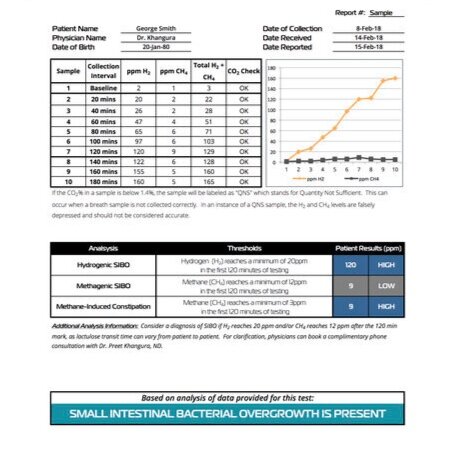
If your symptoms indicate to me that you may have SIBO, before jumping into treatment, it is very helpful to test for it. Not only will this confirm, or deny, a positive result, but it will also guide what type of antimicrobials I’ll use and for how long depending on what the results show. The higher the results, the more rounds of antimicrobials we typically have to do.
SIBO%2BTest%2BReport%2BSAMPLE.jpg

The SIBO breath test is the most accurate non-invasive way to diagnose SIBO right now. Research continues to be done to advance our testing methods. The best option is a breath test that is a 3-hour lactulose breath test looking at both Hydrogen (H2) and methane (CH4) levels. This is the type and amount of gas that is produced if you have SIBO. Hydrogen SIBO typically presents as diarrhea (among other symptoms), and methane SIBO typically presents as constipation. The 3 hour test ensures you are testing the entire length of the small intestine, where only a small amount of bacteria should be, not an overgrowth. Stool testing, which we may do for other GI complaints, is only relevant to the large intestine. There is no accurate test yet for a 3rd type of SIBO, hydrogen sulphide. However, there are patterns on the results and patterns in symptoms that may indicate this type. This is not testing for Candida, however it is common for these to present together.

Ultimately if you test positive for SIBO, I treat it. However, 2/3 of patients have shown to relapse post-treatment. There are number of reasons for this but this is why it is always important to treat the patients and not the condition. I aim to treat the root cause along with the SIBO - if we can. Sometimes this isn’t possible depending on the case, so we do are best. It can also take time, and even different circumstances, for example a less stressful job perhaps, to treat the root. 1/3 of cases are luckily non-recurring and the patients feels better quickly and for good. Phew!

All in all, testing is very helpful to me as a clinician if I suspect a bad case of SIBO. It takes the guesswork out of the treatment and ensures a more accurate and quicker treatment result. Treating SIBO is a team effort but the more information we have the better it can be!

Are you interested in getting tested for SIBO? Let me know!

In health & happiness,

Dr. Karen

The Foodie's Guide to Gluten-Free

I WISH these were gluten free…

I WISH these were gluten free…

As a practitioner that sees a lot of gut health issues, and conditions associated with it, it is likely that I will ask you go try going gluten free. I do this, not because I am trying to be the stereotypical Naturopath portrayed in movies, or because you are celiac, but because it can truly have a negative effect on some people’s health if there is a sensitivity. No, it doesn’t effect everyone, or at least everyone the same, but for those with a more chronic condition that they are seeking help with, it is a great place to start. There is research that shows gluten can increase zonulin in the gut, which I’ve spoken about before, which causes a more “leaky gut.” Gluten can cause different reactions, including the obvious bloating and cramping, to swelling, headaches and fatigue.

Gluten-What?

What the heck is gluten though? Gluten is the protein in certain grains, including wheat, spelt, kamut, rye and barley. It is what makes it stick together well. It is not in oats, millet, buckwheat, corn, rice, quinoa, sorghum. In years past, trying to find gluten free bread that didn’t crumble immediately was almost impossible! Luckily now there are so many great options to choose from. I am creating a guide for those patients of mine that need some guidance, but also all those out there wondering whether this is something they should try for their health. (Hint…if you are asking yourself that, you should probably try it!) Halifax has a few less options than bigger cities, so let me know if there are other favourites I may not know about.

My Gluten-free Tips

  1. My number 1 tip for going gluten free is to not worry so much about replacing every type of gluten product you have. You can do a lot with a lettuce wrap, sweet potato, cauliflower or bed of rice. Try a burger on a lettuce wrap, or seasoned ground meat in romaine. Or even sloppy joes in a roasted sweet potato. You will end up buying less gluten free products and eating more whole foods :)

  2. Bob’s Red Mill is my go-to for gluten free flours for baking. No more complicated recipes needed with a binding agent such as xanthum gum, since their blends are all ready to go and come out tasting great!

  3. Eating out when you are gluten free has become easier as well (except for brunch…that’s still hard for me sometimes!). A lot of restaurants have gluten free options or substitutes so all you need to do is ask. A go to for me is just their meat/fish, potato and veggie dish. There is usually always something like that.

Favourite Gluten Free Products

  • Baking Flour: Bob’s Red Mill 1:1 Baking Flour - the best baking flour I find. It works so well for mostly anything you are baking. (blue bag better than red bag as you need to add the xanthum gum to the latter)

  • Oats: Regular oats - Unless you are celiac, you can use regular oat flakes. These are a go to for me for quick pre-made breakfasts and snacks. I love my oats!

  • Pasta: Cantelli or Barilla gluten free pastas are good grocery store brand options. GoGo Quinoa Pastas are sometimes available and a good option. Kids also tend to like the 100% legume pastas you can find now (eg. Chickapea pasta), which provide a good source of fibre. Be careful with this though if you are sensitive to beans or bloat with too much fibre.

  • Crackers: Blue Diamond Artisan Nut-Thins/Almond crackers, Mary’s crackers are great options as well as several options at Costco that are great. Breton even has gluten free crackers in the regular cracker section.

  • Bagel: O’Doughs Thins - Found at Superstore in the freezer section. They are delicious with a little peanut butter for a quick breakfast if you are craving more carbs (but not with the calories - bonus!). Their sandwich buns are pretty good as well. Little Northern Bakehouse has good bagels as well.

  • English Muffins: Glutino brand - I’m not a big english muffin gal but I’ve been told these are a go to for some people.

  • Bread: This one is a toss up depending on what you are looking for. Some options are - Little Northern Bakehouse Gluten Free bread is apparently really good, especially their Honey Oat Bread; Promise brand from Sobeys; Costco Gluten free bread (comes in a pack of 2 loafs); fresh bread at the market (look around, you may find a gem). Glutino and Udi’s are best for making stuffings etc, since they are still a bit crumbly.

  • Burger buns: O’Dough Hamburger Buns - I discovered these in the summer and I was very impressed! If you aren’t going for the lettuce bun, try these. There are many other options in the freezer sections.

  • Wraps: Superstore has its own wrap that is decent; Sobeys carries ones that aren’t frozen in the health food section. Some can get expensive so look around.

  • Pizza: Sabatassos Gluten-free Pizzas - Since I can’t eat dairy, these came highly recommended by a great source. Found at Costco and they are apparently amazing! Lots of other options now at your local grocery store.

There you have it, some great options for those of us that are gluten free! I promise it isn’t so bad. I love to cook and I’ve made out alright 😉

Any favourite products of yours I’m missing here? Let me know!

In health & happiness,

Dr. Karen

Leaky Gut - Yes there could be "holes" in your gut!

red rover.jpg

As a Naturopathic Doctor who sees a lot of gut issues, I get questioned often by people who have heard the term leaky gut, wondering what it is and if it could be the cause of their health issues. This is something I do see often in practice and I find very important to fix in order to treat a number of different issues, such as IBS, eczema, depression and most autoimmune disorders.

What is leaky gut?

leaky-Gut.jpg

Your gut is actually quite fragile as the lining of your intestines is made up of only 1 layer of cells, called enterocytes, lying between your gut lumen and the blood vessels. A border of microvilli on top increases the surface area to aid in absorption of nutrients, water and electrolytes. The intestinal lining also regulates the trafficking of environmental antigens (1) . These enterocytes are held together by tight junctions, like water-way locks, preventing the cells to come apart when inappropriate. Remember the childhood game red-rover? This is the game your gut is always playing. However, damage to the gut lining from inflammation and stress, releases a protein called zonulin which weakens these tight junctions making the lining more permeable (2) and ultimately creating small gaps between the enterocytes that cannot close up. Food particles, or antigens get absorbed between the cells now instead of through the cells, activating an inflammatory and/or immune response in the gut and blood stream.

What health issues can this cause:

  • Local inflammation - IBS symptoms such as bloating, cramping, diarrhea, constipation

  • Autoimmune conditions (1) - Hashimotos thyroiditis, Rheumatoid arthritis, Lupus and IBD, MS

  • Systemic conditions - eczema, psoriasis, acne, joint pain, headaches, seasonal allergies

  • Mental/emotional issues - depression and anxiety, chronic fatigue

What causes leaky gut:

  • Gluten - this was the first thing found to increase zonulin levels

  • Bacteria and infections - or bacterial endotoxins also found to increase zonulin levels

  • Stress - this decreases stomach acid and digestive enzymes leaving larger particles of food to descend into the intestines which irritate the gut lining

  • Medications such as proton pump inhibitors, antibiotics and NSAIDs

  • Simple sugars and food additives

How to fix leaky gut:

If you haven’t read my blog post about the 4Rs in gut health, I’d lead you there to shed a little more light on my whole gut healing protocol. Ultimately we need to reestablish the zonulin-dependent intestinal barrier function to close up those gaps between the cells. There are a few favourites of mine that been shown to be very effective at REPAIRING the gut, but don’t forget to REMOVE, REPLACE and REINOCULATE as well.

  • L-glutamine - this is my go-to for any gut issues, from mild to major. Always given in powder form to ensure a high enough dose.

  • Collagen - helps to support and strengthen the gut lining like glutamine. I love the brand Sproos that I carry in my practice.

  • Zinc carnosine - studied to heal the gut, including the stomach lining after H.pylori or an ulcer or after NSAID use

  • Mucilaginous herbs - marshmallow, aloe vera, DGL, slippery elm

If you struggle with any of the conditions listed above do not hesitate to reach out to discuss the best treatment options for you! Heal your gut to heal your body and start feeling yourself again.

In health & happiness,

Dr. Karen

References:

1 - https://www.ncbi.nlm.nih.gov/pmc/articles/PMC3384703/

2 - https://www.ncbi.nlm.nih.gov/pubmed/21248165

3 Causes of SIBO That Have You Suffering

matthew-henry-58760-unsplash.jpg

Irritable bowel syndrome has been a diagnoses of exclusion for many years. If the symptoms are severe enough you are referred for a colonoscopy or an endoscopy, and if tests are clear you are given the diagnosis. If the symptoms are mild enough, no testing is done and the diagnoses is given. This is an umbrella term however. In my practice I see varying causes of IBS since we are looking at the root cause. SIBO, or small intestinal bacterial overgrowth, is one very common cause of IBS. MDs do not have access to other GI tests like a SIBO breath test, or lack knowledge that SIBO is something that can be treated. I see many people with irritable bowel syndrome that show typical signs of SIBO. We test for it and treat accordingly. But WHY do they have it is the big question? 

Symptoms of SIBO

Common symptoms of SIBO are bloating, either with no known trigger food or very predictable trigger foods such as garlic, onion, greens, apples etc, abdominal pain, heartburn, either chronic constipation or diarrhea. Other associated conditions are rosacea, cystic acne, chronic pain, IBD, and even hypothyroidism! The list goes on. This is why I ALWAYS ask you about your gut! 

What Causes SIBO

There are many causes of SIBO that have been shown but I want to point out the most researched and most common causes. One of these may relate to you. 

  • Food poisoning - aka bacterial gastroenteritis. This is actually the #1 cause of SIBO. When you get food poisoning your body produces certain antibodies that decrease the motility of your gut. The wave of motility is called your migrating motility complex (MMC) and it is a very important housekeeping function of your gut to clean everything out in the directly of your bowels. When the MMC is disrupted certain “bad” bacteria in your large intestines can ascend upwards into your small intestines and start fermenting foods they aren’t supposed to (aka SIBO). Note - if you’ve had food poisoning once you are more likely to get it again due to the production of these antibodies so please be careful. 

  • Stress - This is the most common cause I see in practice. When we have chronic stress our bodies are in fight or flight mode and not rest and digest mode. This leads to a decrease in stomach acid, digestive enzymes and bile production. Stomach acid and enzymes suppress the growth of bacteria and they are also helpful in stimulating the MMC. Stress also affects the enteric nervous system (that gut-brain connection) which stimulates the MMC.

  • Abdominal strictures or adhesions - Scar tissue can occur from abdominal surgery, Crohns or Colitis or even endometriosis. The scar tissue then interrupts the proper flow of the gut, aka the MMC. 

As you can see all those causes have an affect on the MMC in our gut. The list does go on unfortunately including issues such as hypothyroidism, opiate use and even traumatic brain injury. 

If you suffer from the above symptoms, have been diagnosed with irritable bowel syndrome but given no treatment, or have digestive issues and have dealt with any of the issue above do not hesitate to get in touch. Let’s get to the root cause of your digestive concerns and help you feel better for good!

In health & happiness, 

Dr. Karen