
perimenopause

How Your Menstrual Cycle Changes in Perimenopause - and Why tracking It Matters

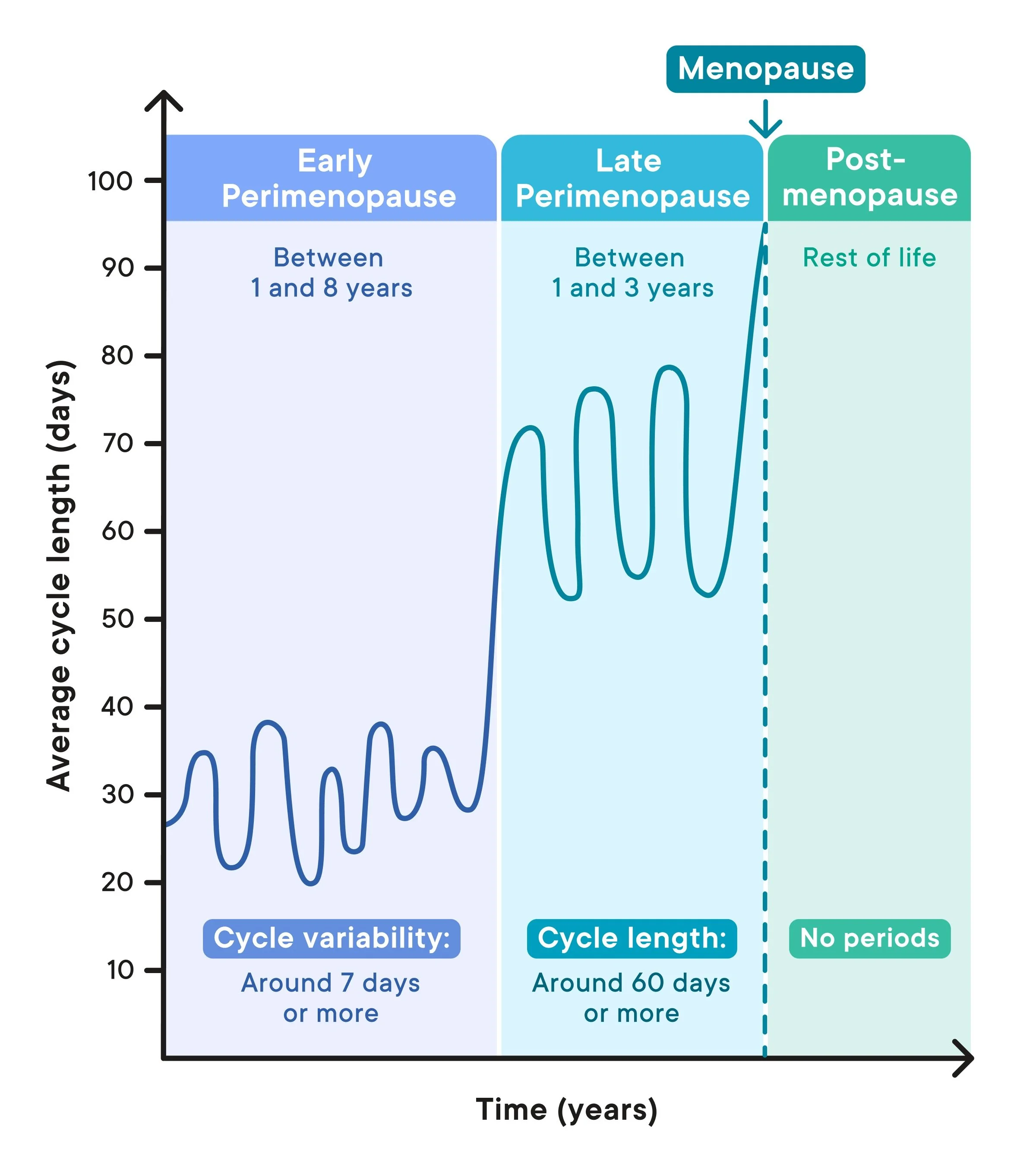
Perimenopause is not a single moment—it’s a multi-year hormonal transition that unfolds in stages. One of the earliest and most reliable clues that you’ve entered this phase is a change in your menstrual cycle.
www.helloclue.com


Understanding how your cycle is changing can help you:

  • Identify where you are in the menopausal transition

  • Understand the hormonal patterns driving your symptoms

  • Choose the most appropriate treatment strategy for your body

  • Decide whether testing may be helpful (especially if you don’t bleed due to an IUD)

Let’s break down what’s normal, what’s not, and how tracking can guide care.


The First Sign of Perimenopause: A Changing Cycle

In your reproductive years, your cycle is typically predictable—often within a 2–4 day window each month.

In early perimenopause, the defining change is:

A cycle that shifts by 7 days or more—earlier or later—compared to your usual pattern.

This may look like:

  • A period arriving 7–10 days earlier than expected

  • A cycle that suddenly stretches 1–2 weeks longer

  • Month-to-month unpredictability

This is often driven by inconsistent ovulation, fluctuating estrogen, and rising progesterone deficiency.


Later Perimenopause: Longer Gaps Between Periods

As you move further into the menopausal transition, the ovaries begin to respond less consistently to brain signals.

In later-stage perimenopause (which may last 1–3 years), you may notice:

  • Skipped periods

  • Cycles that stretch beyond 60 days without bleeding

  • Heavier or prolonged bleeding when periods do return

At this stage, hormone fluctuations are more extreme, and symptoms such as hot flashes, sleep disruption, anxiety, and heavy bleeding often intensify.


Why Cycle Tracking Is So Powerful

Tracking your cycle is not just about dates—it helps determine:

1.  Where you are in the transition

  • Shorter or variable cycles → earlier perimenopause

  • Long gaps (>60 days) → later perimenopause

2.  Which treatment options may be most supportive

For example:

  • Heavy + more frequent periods
    → often seen in early perimenopause
    → a hormonal IUD may be a helpful option if blood loss is leading to other issues and can’t be controlled naturally - ie. anemia!

  • Heavy + infrequent periods
    → often seen in later perimenopause
    → an IUD may not be the best fit if the heaviest is infrequent and menopause is now expected in 1-3 years version who knows how many years!
    → other hormone or non-hormonal strategies may be more appropriate


Without tracking, these patterns are easy to miss—and treatment choices may not match your true hormonal stage.


What If You Don’t Get a Period Because of an IUD?

If you have a hormonal IUD and no longer bleed, cycle tracking isn’t possible—but this is when lab testing can help.

FSH Testing in Perimenopause:

FSH (follicle-stimulating hormone) rises as the ovaries become less responsive. In late-stage perimenopause and menopause:

  • FSH levels are often consistently above 25 IU/L

To confirm a menopausal transition when cycles are absent:

  • Two FSH levels >25 IU/L

  • Drawn at least 3 months apart

This can help determine:

  • Whether you are still in perimenopause

  • Whether you may be transitioning into menopause

  • Which therapies are safest and most appropriate


The Takeaway

Your cycle is one of your most valuable hormonal data points.

Whether you’re:

  • Noticing unexpected changes

  • Skipping periods

  • Bleeding more heavily

  • Or no longer bleeding due to an IUD

Tracking (or testing when needed) allows us to:

  • Identify your stage

  • Understand your symptoms

  • And personalize your treatment plan


Perimenopause is not something to “wait out.” With the right insight, it can be navigated with clarity and confidence.
Perimenopause 101 - How to tell you are in it

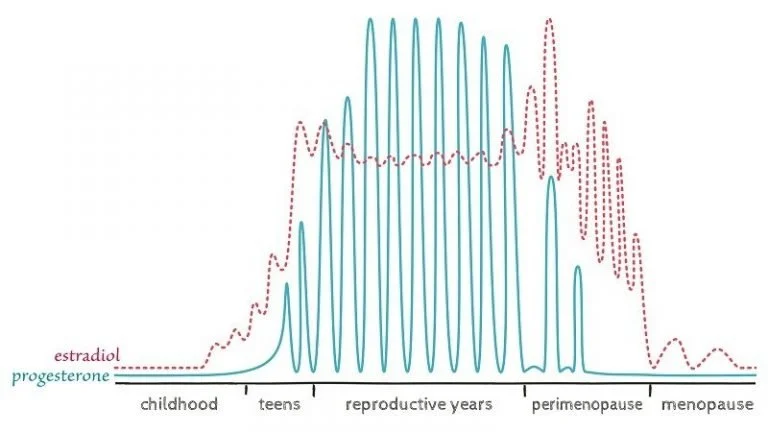
Diagram from Lara Briden’s Hormone Repair Manual

Perimenopause is a gradual transition that typically begins in a woman's 40s, marking the lead-up to menopause. It's important to note that for women over 45, perimenopause is typically a clinical diagnosis and does not require lab assessment for confirmation. To help you recognize if you're entering this phase, here are some key signs to look out for:

  • Changes in menstrual patterns: Your periods may become irregular, with cycles becoming longer or shorter. You might still have periods, but the consistency and frequency may vary. Often your period becomes shorter before it gets less frequent.

  • New physical symptoms: You may experience hot flashes, night sweats, or changes in your skin and hair. Vulvar and vaginal symptoms can also occur while you're still menstruating. You may also have an exacerbation of pre-existing symptoms such as breast tenderness.

  • Insomnia and sleep changes: As your hormones fluctuate your sensitivity to that could cause worsening of sleep, either a few days before your period or throughout the cycle.

  • Mood changes: Some women notice shifts in their emotional state, including increased irritability or mood swings. It's important to note that while mood changes are common, severe depression should be addressed with a healthcare provider.

To better understand and manage your perimenopause journey:

  • Track your symptoms: Keep a record of your menstrual cycles and any new symptoms you experience. This can help you identify patterns and provide valuable information to your healthcare provider.

  • Get appropriate testing: Again hormone testing does not diagnose perimenopause however getting baselines of B12, ferritin, liver enzymes, lipid panels can be helpful to assess your overall health and cardiovascular risk (one thing we care about the most!)

  • Consider your family history: Ask your mother about her menopause experience, as there can be genetic similarities. Ask about family history of osteoporosis and cardiovascular disease. These areas of health are important to monitor in women’s health.

  • Seek expert help: Consider seeing a menopause practitioner who specializes in this life stage to get targeted support and avoid misdiagnosis.

Remember, every woman's experience with perimenopause is unique. By staying informed and proactive about your health, you can navigate this transition more smoothly and ensure you receive appropriate care and support.

Menopause: Is it hot in here, or is it just me?!

Catch yourself saying this often? There is a logical explanation for it...hormones!

Menopause is a normal physiological change women experience at some point in their life. It is not something we should try to prevent but also not something we have to ignore. Several things can help women adapt to these hormonal changes. The typically age of menopause is 51, but it is normal to experience symptoms 5-6 years on either side. Women can also be jolted into menopause at an earlier age due to such things as a bilateral oophorectomy (removal of both ovaries), chemo/radiation or even a very stressful event. Also, all women experience menopause differently, which is why individualized treatment is important to see the greatest improvement.

Common/classic symptoms:

Photo: http://www.life-saving-naturalcures-and-naturalremedies.com/home-remedies-for-hot-flashes.html

Photo: http://www.life-saving-naturalcures-and-naturalremedies.com/home-remedies-for-hot-flashes.html

  • changes in your menstrual cycle
  • hot flashes/night sweats
  • sleep disturbances
  • vaginal dryness
  • low libido

Other symptoms that may be associated with menopause:

  • anxiety/depression
  • memory issues
  • urinary incontinence
  • weight gain
  • skin/hair changes (dry skin; more or less hair)
  • fatigue
  • joint pain
  • headaches
  • dry eyes

What is happening?

A little terminology: Perimenopause is the period immediately before menopause, starting with changes in the menstrual cycle and ending 12 months after the final period. Postmenopause begins after the final period. Menopause encompasses all of this.

During our childbearing years, our bodies secrete estrogen, progesterone and FSH (among other hormones) to regulate our cycle, produce an egg, stimulate ovulation and create a menses every month. As we age, the number of ovarian eggs decrease and these hormones begin to change. FSH levels initially rise during perimenopause, then progesterone levels begin to decline (less produced in your ovaries). This typically initiates a longer, heavier and/or less frequent period. Finally, close to the end of perimenopause, estrogen levels decline, causing those dreaded hot flashes/night sweats and dryness (everywhere!). The variety of different menopausal symptoms occur as these hormones have many effects in our body and there is a strong connection between your sex hormones and stress hormones. 

What can you do to improve your symptoms?

About 75% of menopausal symptoms can be managed with non-hormonal strategies, including diet, herbs and lifestyle changes. 

Diet:

  • Eating a whole foods colourful diet is always a good start to ensure adequate nutrients. 
  • Adding omega 3s, found in fish/fish oil, nuts and seeds will help decrease inflammation causing more severe menopausal symptoms. Several studies have shown a decrease in hot flashes and depression with omega 3s. 
  • Flax seed is a good source of omega 3 but also acts as a pytoestrogen (mimic or blocks estrogen depending on what is needed). In this case, it mimics estrogen to minimize symptoms. One tablespoon ground per day is an adequate dose.
  • Eating adequate good fats is important for hormone synthesis but will also help with lubrication. Think oils, butter/ghee and avocado. 
  • Finally, noticing symptom triggers and avoiding them as much as possible is key. Common hot flash triggers are alcohol, caffeine and spicy food. 

Herbs: Several botanical herbs have been studied around their effectiveness on menopausal symptoms and may be all that is needed.

  • Black cohosh has been shown to decrease several symptoms including hot flashes/night sweats, joint pain and depression and is safe in breast cancer.  
  • More recently Maca has popped up and has been shown to have the most effect on low libido. 
  • Saint John's Wort is very effective in taking "the edge off" if you are feeling anxious or depressed, as well as improving hot flashes.
  •  Considering the connection to the adrenal (stress) gland, Ginseng or Ashwagandha may be the right herb. It acts on the adrenal glands to improve psychological well-being, fatigue and sleep.
  • Finally, Valarian can be taken in combination with any of these herbs for insomnia due to night sweats.

These herbs are just a few herbs I tend towards for my patients. Consult an ND to find the right herbs and doses for you.

If diet and herbs have not made a significant change in your menopausal symptoms, bio-identical hormonal therapies, or conventional medication may be indicated. Bio-identical hormones mimic our natural hormones to elicit the same physiological response. The dose is dependent on the individual. Hormonal therapy and medication can have both benefits and risks. I recommend starting with the most natural strategies and work from there. 

Remember this is a new phase of life, meaning an opportunity to reassess your health status as well as create new life goals for this next phase. I am solely here to help you along the way.

In health & happiness, 

Dr. Karen