Food Friday: Moroccan Fall Vegetable Stew

Well it is officially fall! My favourite season. So far, fall in Nova Scotia isn't too shabby with warmer temperatures sticking around during the day, but we will soon see the colours start to change and scarves making the yearly come-back. 

Another sign of fall is finding a variety of squash at your local market. For me that happened last week when I found the hard to find delicata squash at the Halifax Forum Market! Finding this squash only means making my favourite moroccan fall vegetable stew, from the Whole Life Nutrition cookbook. This is a wonderful stew that celebrates the flavours of fall with warming spices rich in beta-carotene and antioxidants. It a great dish if you are avoiding meat, gluten or dairy, filled with nutritious squash, potatoes and carrots, and topped with a little sweetness. It may seem like a lot of ingredients but it comes together easily and is worth it. I serve it over a little quinoa with a side green salad. This stew never fails to impress!

Ingredients:

The delicata squash :)

The delicata squash :)

  • 2 tbsp extra virgin olive oil

  • 1 large onion, chopped

  • 6 cloves garlic, minced

  • 2 tsp ground cardamom (I get mine from Bulk Barn)

  • 2 tsp curry powder

  • 2 tsp sea salt

  • 1/2 tsp freshly ground pepper

  • pinch cayenne pepper

  • 3 large carrots, diced

  • 3 medium red potatoes, diced

  • 1 small delicata squash, peeled, and cut into chunks

  • 1/2 cup Zante currants (or regular, again from Bulk Barn)

  • 2 cups tomato sauce

  • 2 cups cooked chickpeas (to make your own, soak overnight and cook)

  • 1 cup water

  • 1/2 cup dried figs, chopped

  • 3/4 cup almonds, toasted and chopped

  • fresh mint for garnish

Recipe:

  1. Heat a large pot over medium heat, and add the olive oil. Add the onion and saute until tender, about 3-5 minutes.

  2. Add the garlic, then the cardamom, curry powder, salt, pepper and cayenne. Saute and stir a few minutes more.

  3. Next add the carrots and potatoes. Stir well to coat with the oil and spices. Saute-stir for about 5 minutes, then add the squash and stir. Add the currents, tomato sauce, chickpeas and water. Place a lid on the pot and continue cooking until the vegetables are tender, about 25-30 minutes, stirring occasionally and adding more water if necessary.

  4. Toast the almonds for about 10 minutes at 350F (or in a toaster oven like I do).

  5. Before serving, sprinkle the figs and almonds on top of the stew. Top with freshly chopped mint. (Or save some nuts and figs for leftovers). Serves 4-6.

Enjoy!

In health & happiness,

Dr. Karen 

(Photo credit: divinedestinationcollection.com, nesfp.org)
Food Friday: Sprouting 101

Happy Friday fellow health nuts! It's the long weekend! Im off to celebrate a beloved friend's wedding this weekend and it is going to be beautiful. What are you getting up to?

Lately I have been experimenting with new food prep techniques and making a lot of whole foods myself. What a thrill when you know exactly how your food is made/prepared, hence know exactly what you are putting in your body. I just recently started sprouting because of the ease and the nutritional benefits. Thanks to Costal Healing and Whole Life Nutrition for the inspiration!

Why sprouts?

There are several reasons why choosing to make your own sprouts is beneficial.

  • First of all it is very easy and cheap! You just have to remember to rinse them a couple times a day. Having an at home garden makes me think my green thumb is improving. :)
  • They are very nutritious. Since beans sprout from just adding water, they are packed full of important nutrients that the plant will need in its initial few days. Therefore they are very nutrient dense, with little calories. Other examples of nutrient dense foods are liver, eggs, lamb, leafy greens (especially baby greens).
  • Sprouts have many health benefits. Because of their packed storehouse of nutrients, including vitamins, minerals, antioxidants, enzymes and fibre they can help battle conditions such as digestive and bowel issues, blood pressure and cholesterol issues, a poor immune system, skin issues...you name it!
  • Broccoli sprouts contain sulforaphane. This is a powerful antioxidant and detoxification chemical. These sprouts can take a little longer to start sprouting so be patient. 

What you will need:

  • 1-L wide-mouth mason jar - You can pick a pack up at Canadian Tire, find at thrift stores or buy a couple at Michaels. 
  • Plastic needlework canvas - You can find this at Michaels for 99 cents (or any craft store). The finer canvas works best for smaller sprouting seeds. (Sprouting lids are available online for a cost, but it is very easy to make your own.)
  • Sprouting seeds - Mung and alfalfa are typically the easiest to start with but broccoli sprouts are even more nutritious. You can find seeds at places like Halifax Seed. 

How to sprout:

sprouting101dr.karen.jpg
sprouting101-2dr.karen.jpg
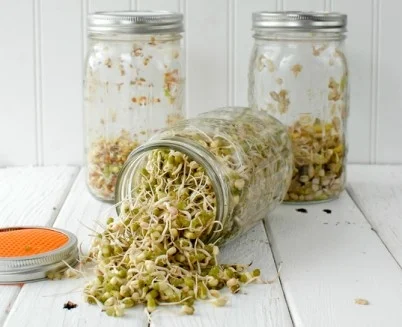
  • To make the sprouting lid, trace the metal lid on the needlework canvas. Cut the circle out and insert into the mason jar lid ring (without the inner circle). Voila!
  • Place 2 tbsp of sprouting seeds in the mason jar. Cover with a few inches of water, screw lid on, and let soak overnight in a warm dark place. After 6-10 hours, drain the water. 
  • Rinse the seeds with water twice a day, draining the jar completely each time. Store in a warm dark place, tilted at an angle in a bowl, so any excess water drains out. The sprouts should be moist but not sitting in water. 
  • Once the sprouts have grown a few centimeters and have defined yellow leaves, place the jar in a bright place to be exposed to sunlight to green. Continue to rinse to ensure they do not dry out. 
  • Store sprouts in the refrigerator for up to a week. Enjoy on salads, sandwiches or as a snack. 

Any other at home garden tips?

In health & happiness,

Dr. Karen

(Photo credit: www.boulderlocavore.com)

From Around the Web

Summer sure has flown by! Here are some interesting links to keep you in the spirit of summer but also prep for school. 

1. Some great ideas for your children's lunches come September. 

2. Tips to enjoy summer fruit without eating too much sugar. 

3. How stress controls our sweet cravings. 

4. A guide to some hard-to-pronouce added ingredients in your food? Are they good or bad?

5. Strawberry cashew milk! Do this while the strawberries are still good. You could even make them into popsicles. 

6. Suffer from PMS? Its never a good time in the summer! Here are some natural remedies to fight it.

7. Take a break this summer. Studies show long working hours do not lead to more productivity.  

8. Finally, a great resource to get back on track with your weight and diet after indulging this summer.

In health & happiness,

Dr. Karen

(Photo credit: www.simple-balance.ca, www.hbr.org, www.realfoodwholelife.com)

Bugs to avoid bugs: How probiotics can improve your child's immune system

The summer heat has finally arrived...just in time to gear up for school again! If you have small children going into day-care or school in a few weeks, consider improving your child's and your gut health to avoid those nasty bugs that inevitably go around.

Study time:

There is a plethora of research coming out recently proving that a healthy gut goes a long way to improve your digestion, mood and even your immune system. For children in day-care, that is good news, because there are things you can do as a parent to protect you and your child. There are little bugs, or healthy bacteria, that live in our gut that ward off the unhealthy bacteria that lead to illness. Probiotics are those healthy bacteria and you can add them to your child's diet, as well as yours in several ways. A 2014 meta-analysis looking at the impact probiotics have on children's immunity showed that parent and child pairs that took probiotics had fewer colds and flus, shorter duration of colds and less sick days. Taking a good quality, multi-strain probiotics is a great way to get probiotics, but also consider fermented foods, yogurt (if you or your child aren't sensitive to dairy) or coconut kefir. There are even specific children probiotics available in powder form that you can mix with juice, apple sauce or other easy foods. Also, any antibiotics (remember all those nasty ear infections), kill both bad and good bacteria so it is even more important to introduce probiotics back into gut after taking antibiotics.

But how does this work?

Surprisingly, the majority of your immune system resides in your digestion system. It is called your gut-associated lymphoid tissue, or simply GALT, and works to protect your body from invasion of any illness by producing immune cells that fight them off. It is proposed that probiotics adhere to gut tissue, in turn activating GALT. The stronger your digestion system is, the stronger your immune system will be. And remember, immune health is important at all ages so eat your probiotics! 

In health & happiness,

Dr. Karen

(Photo cred: www.sciencemag.com; www.todaysparent.com)